
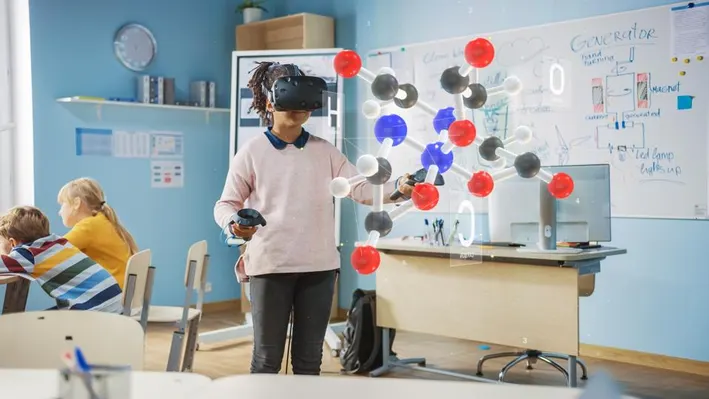
Education is evolving rapidly with the integration of Augmented Reality (AR) and Virtual Reality (VR). These immersive technologies are redefining traditional learning methods by making education more interactive, engaging, and effective. By bridging the gap between theory and practice, AR/VR is enhancing knowledge retention and student engagement across various educational domains.
In this blog, we explore how AR/VR is revolutionizing education and the benefits it brings to students and educators alike.
Enhancing Classroom Learning
AR and VR create interactive learning environments that make complex concepts easier to understand.
- Immersive Lessons: Virtual field trips transport students to historical landmarks, space, or even inside the human body for a hands-on learning experience.
- 3D Visualization: AR applications bring textbooks to life by overlaying interactive 3D models, helping students grasp difficult subjects like biology and physics.
- Real-World Simulations: VR enables students to experience real-world scenarios, such as scientific experiments or historical events, without leaving the classroom.
Improving Student Engagement and Retention
Traditional teaching methods often fail to keep students engaged. AR/VR makes learning more captivating and memorable.
- Gamified Learning: Interactive VR games encourage active participation, making education fun and motivating students to explore new topics.
- Personalized Learning: Adaptive AR/VR experiences cater to individual learning styles, allowing students to learn at their own pace.
- Experiential Learning: Hands-on virtual experiences boost retention rates and reinforce classroom teachings.
Revolutionizing Skill Development and Training
AR and VR are not limited to academics—they also play a crucial role in skill-based education and vocational training.
- STEM Education: VR labs allow students to conduct science experiments safely without the need for expensive lab equipment.
- Medical Training: Medical students practice surgical procedures in a risk-free VR environment, improving their precision and confidence.
- Technical Training: AR guides learners through step-by-step processes, such as machine operation, automotive repair, and electrical work.
Breaking Barriers in Remote Learning
AR/VR makes remote learning more interactive, ensuring students receive a high-quality education regardless of location.
- Virtual Classrooms: Students can attend lessons in a 3D VR environment, interacting with teachers and peers in real-time.
- Augmented Collaboration: AR enhances group projects by enabling students to work together on interactive assignments, even from different locations.
- Access to Resources: Virtual libraries and AR-based study materials provide instant access to vast educational content.
The Future of AR/VR in Education
As technology advances, AR/VR will continue to shape the future of education. AI-powered personalized learning, haptic feedback for immersive experiences, and cloud-based virtual classrooms are just the beginning of what’s to come.
At ffazAR, we develop cutting-edge AR/VR solutions that make learning more engaging and effective. Whether it’s immersive training simulations, virtual labs, or interactive classroom content, our technology is redefining education for the digital age.